
Marquette Inmate Release Dates
A projected date is a prospective point derived from a judgment, sentence rules, credits where legally available, and later agency decisions. An actual release date records that the person physically left a facility. Michigan uses several date labels that must not be collapsed. For an MDOC prisoner, the Parole Board Jurisdiction Date is the earliest release date, also called ERD, when the Board may obtain jurisdiction. The Maximum Date is a potential sentence endpoint. Date Paroled is historical and records when the person actually left prison on parole.
Most Michigan felony sentences are indeterminate. The court sets a minimum while law supplies the maximum. Reaching the minimum or ERD opens the parole decision stage for an eligible prisoner. It does not compel a grant. If parole does not occur, the sentence can continue toward its maximum, subject to the governing law and any applicable legacy calculations. The Judgment of Sentence is the starting legal record, while OTIS presents public corrections fields.
Find Marquette Projected Release Dates
First identify the custodian. Marquette County Jail, Marquette Branch Prison, BOP, and ICE use different records. For an MDOC prisoner, search OTIS with the unique MDOC number when known. A last name is the minimum name search. First name, age range, sex, race, status, and other details can narrow results. Open the full profile and compare the sentence and location with the known case before reading any date.
- Find the Judgment of Sentence in the relevant court record and confirm whether it imposed county jail, MDOC prison, probation, or another disposition.
- For an MDOC sentence, open the OTIS offender search and match the person by MDOC number or identifying fields.
- Read the status, Parole Board Jurisdiction Date, Maximum Date, location, sentence, and Date Paroled if present.
- For a Marquette County Jail sentence, ask the sentencing court and Sheriff records custodian for the commitment, credited time, and recorded release entry.
- For a pending custody change, register through the Marquette VINELink Release Check, then verify the event with the responsible agency.
A pretrial detainee has no computed sentence release date. A bond entry or dismissal may authorize release, but other holds and processing can remain. Ask the jail for the recorded exit time and disposition. If a court sentence sends the person from Marquette County Jail to MDOC, that local departure is a transfer. The future prison release path then shifts to OTIS and MDOC records.
Read Marquette OTIS Release Fields
The OTIS field guide defines the public terms used in Michigan state-prison records. Read them as a sequence, not as substitute labels. Status tells whether the person is a prisoner, parolee, probationer, absconder, or discharged MDOC offender. Location helps separate a prison from a community supervision office. Sentence and controlling MCL details connect the dates to the conviction.
| OTIS field | Correct release-date meaning |
|---|---|
| Parole Board Jurisdiction Date | Earliest release date or ERD when the Board may obtain jurisdiction, not a guaranteed exit |
| Maximum Date | Potential maximum sentence endpoint, subject to the governing sentence and law |
| Date Paroled | Historical date the person physically left prison on parole |
| PAROLE | Released from prison but still under MDOC community supervision |
| DISCHRG | MDOC jurisdiction ended, which may occur after an earlier prison exit |
| PRISON | The person remains in an MDOC institution even if a future date appears |
The MDOC sentence and status terminology appears in the official Michigan corrections glossary.
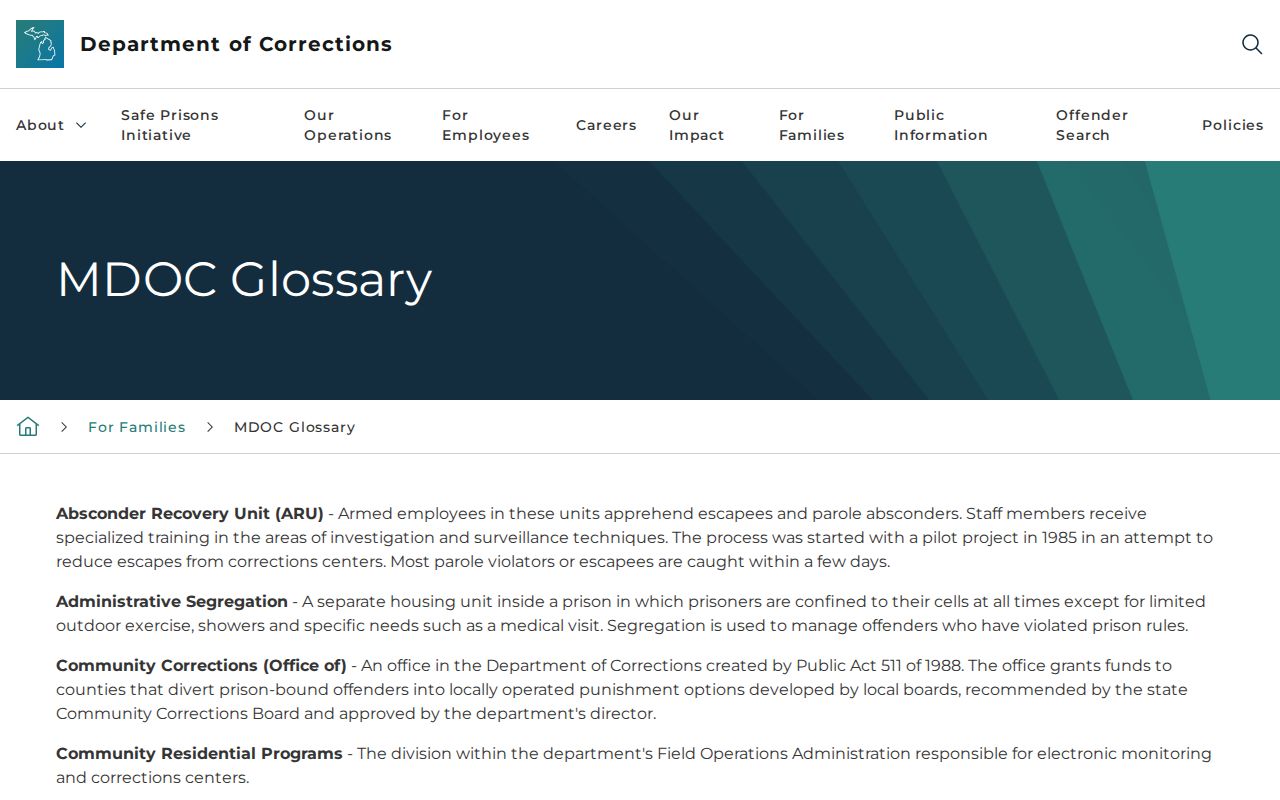
Those definitions prevent the earliest parole-review point from being reported as the date a Marquette Branch Prison inmate actually left custody.
OTIS covers people currently imprisoned, paroled, or probationed under MDOC supervision and those discharged within three years of their most recent MDOC discharge. It excludes county-jail-only inmates, jail-only sentences, people not yet sentenced, and certain exempt records. A missing profile can therefore mean the wrong system was searched, the public discharge window ended, or legal action removed the record from public view. It does not establish a release date. Use the sentencing court and the correct records custodian when OTIS has aged out or never covered the case.
Marquette Truth in Sentencing
Michigan is not governed by a blanket rule that every prisoner serves 85 percent for this calculation. The MDOC Truth in Sentencing explanation says covered offenses require service of 100 percent of the judicial minimum in prison before parole consideration. It applies to specified assaultive offenses committed on or after December 15, 1998, and other covered offenses committed on or after December 15, 2000.
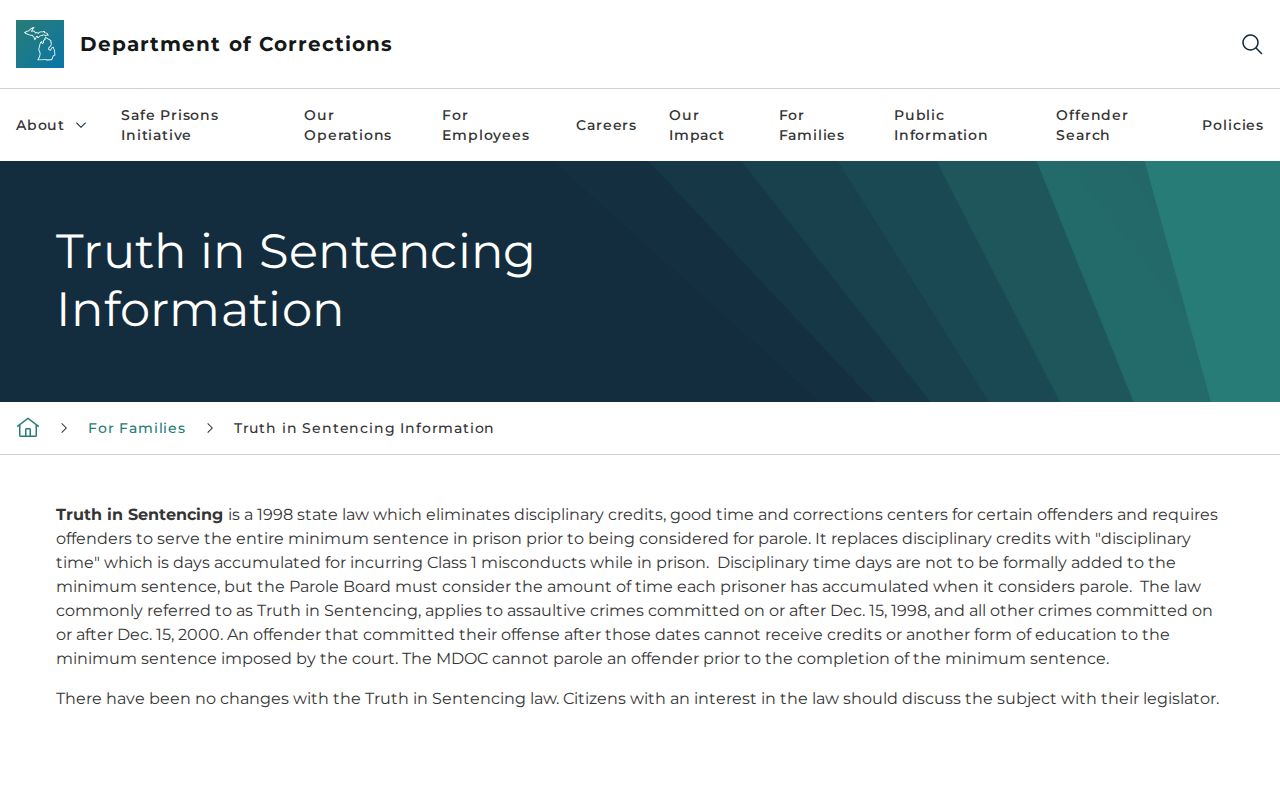
The state guidance supports using the full judicial minimum for covered modern offenses, not subtracting a guessed percentage or present-day good-time award.
Truth in Sentencing eliminated good-time or disciplinary-credit reductions of that minimum for the covered cases. Class I misconduct disciplinary time is considered by the Parole Board rather than displayed as a new guaranteed exit date. After the minimum is served, the Board must still act under the parole statutes. MCL 791.233 sets the public-safety standard and other restrictions, while MCL 791.234 addresses Board jurisdiction and sentence categories.
Note: Serving the full minimum opens parole consideration in a covered case; it does not require release on that day.
Marquette Legacy Release Credits
Older offenses can involve legacy disciplinary-credit law. The MDOC glossary describes historically available credit at five days per month plus two more days for exceptionally good behavior, up to 84 days per year. Credits were subject to loss for misconduct and to statutory limits. MCL 800.33 and MCL 800.34 govern those older regimes.
Offense date matters. A legacy formula must not be applied to a current post-cutoff prisoner. The sentence, controlling statute, judgment, and MDOC calculation must be read together. If OTIS is too brief, MDOC’s formal records route may provide a Basic Information Sheet, Parole Eligibility Report, Judgment of Sentence, or Discharge Certificate when available and disclosable. Public OTIS data is a lookup tool, not the full computation file.
Life sentences also require care. Under MCL 791.234, parolable life generally reaches Board jurisdiction after ten calendar years for a crime before October 1, 1992, or fifteen years for a crime on or after that date, subject to exceptions and procedure. Nonparolable categories, including first-degree murder and other specified or expressly nonparolable offenses, cannot be assigned that timeline. Mandatory life without parole must never be treated as parolable life.
Why Marquette Release Dates Change
A valid projected date can change or fail to become an actual release. Some causes arise in court. Others come from sentence administration, conduct, another custody system, or Parole Board action. The narrow question is what each new event did to the legal sequence.
| Factor | Possible effect | Record to check |
|---|---|---|
| Amended sentence or credit correction | Changes the controlling calculation | Judgment, amended order, and MDOC record |
| Legacy credit loss or misconduct | May affect an older applicable calculation or Board decision | MDOC sentence and disciplinary record |
| Additional sentence or detainer | Can continue custody or cause transfer | Court record and receiving agency |
| Board denial or deferral | Prevents release at the hoped-for point | Notice of Action and later OTIS status |
| Placement not complete | Can delay processing after a favorable action | MDOC release processing record |
| Grant suspended or rescinded | Withdraws or changes a proposed action | Updated Board and MDOC record |
| Database lag | Public fields may not yet show the newest event | MDOC, court, or jail confirmation |
A positive parole action is still not a prison exit. MDOC says release processing and placement follow the decision, and at least 28 days normally separate a decision from physical release. Later adverse information can change the action. The useful record chain is Judgment of Sentence, then ERD or jurisdiction date, then Board action, release processing, and finally OTIS Date Paroled with PAROLE status.
Marquette Jail Release Date Requests
No official Marquette County jail good-time, weekend-release, or Sunday-to-Friday policy was located in the research. MDOC rules cannot be copied onto a county-jail sentence. Ask the sentencing court and the Sheriff records custodian for the commitment, credited time, and recorded release date. If the person is awaiting trial, ask for current custody and court status rather than a projected sentence date that does not exist.
A focused county request should identify the person and booking period, then ask for booking date and time, release date and time, release authority or disposition, bond and case entries, and receiving agency if the event was a transfer. MiCOURT may show bond, time served, dismissal, sentence, or another legal event. The Sheriff record supplies the physical exit. A bond order can precede processing, and a time-served sentence can coexist with another hold.
Federal and immigration cases remain separate. Leaving Marquette County Jail for USMS, BOP, or ICE is a transfer from the local facility, not community release. The BOP locator can display a release date for its population, but “Released” or “Not in BOP Custody” ends only BOP custody. ICE’s locator checks current adult detention and does not provide a historical release date.
Confirm Marquette Actual Release
Use the record that owns the final event. For Marquette Branch Prison or another MDOC institution, look for Date Paroled with PAROLE status, or a recent DISCHRG status understood as the end of MDOC jurisdiction. For Marquette County Jail, obtain the booking/release entry. For a federal case, read the BOP record within its limits. A transfer alert requires following the next custodian.
MI-VINE can add a pending custody-change alert for a county jail or MDOC record, but notification is not a sentence calculator. Court records explain the judgment. OTIS presents public MDOC status and dates. Agency records resolve an exact exit or discrepancy. The safest conclusion preserves the label, source, and scope, such as “OTIS lists Date Paroled” or “Marquette County Jail recorded a transfer,” instead of converting every date into one broad claim.
For an older or incomplete MDOC profile, identify the person by full name and MDOC number and ask for the available formal record. MDOC guidance describes PENPACK material that may include a certified presentence investigation report, Basic Information Sheet, Parole Eligibility Report, Judgment of Sentence, photograph, fingerprints, and Discharge Certificate. Exempt material can still be withheld. The Discharge Certificate can confirm the end of MDOC jurisdiction, while Date Paroled remains the public field for an earlier physical exit to parole when that event occurred.