
Marquette Released Booking Photo Records
A booking photograph identifies the image connected to a booking episode. Release does not by itself erase the underlying government record, but it often removes the person from a live custody view. Marquette County publishes no browser archive of released mugshots and no retention period for photos in its mobile inmate lookup. The safe question is therefore whether the Sheriff still possesses the associated image and whether it is disclosable under Michigan law.
Michigan FOIA supplies the request framework. It does not guarantee that every image is public in full. The custodian may apply an exemption, redact material, or state that no responsive record exists. Law-enforcement investigation, privacy, security, medical, juvenile, and other protected information can require separate analysis. MCL 15.244 calls for nonexempt parts to be separated and produced when practicable.
A mugshot also proves less than many readers assume. It documents an image made during an arrest or booking. It does not establish conviction, current custody, or a later community release. Pair it with the booking number, case, recorded release event, and source agency.
The same person can also have more than one booking image. Dates, booking numbers, and agency labels prevent a photo from one custody episode from being attached to another. When an image has been cropped away from its caption, return to the official record before describing it.
Marquette Released Mugshot Channels
Photo access depends on the custody system. A county-jail photograph belongs with the Sheriff’s booking record. A state-prison image may appear in MDOC OTIS or formal MDOC material. Court registers help confirm legal events but should not be promised as photo repositories.
| Channel | Photo status | How to access it |
|---|---|---|
| Sheriff app | Current detail may need inspection; no released archive is promised | Use the official app as a current-custody clue. |
| Sheriff FOIA | Associated booking photograph may be responsive | Identify the person and booking episode; ask for electronic delivery. |
| MDOC OTIS | Many public state-offender profiles include a photo | Search by name or MDOC number, subject to system scope. |
| MDOC formal record | A PENPACK may include a photo if available | Use the state records route for an MDOC case. |
| MiCOURT | Not a promised mugshot source | Use the register to verify case and disposition context. |
| News or press release | A historical image may remain | Treat it as reporting, then verify current status with official records. |
| Commercial mirror | May be stale or misidentified | No commercial mugshot or removal service is linked or endorsed. |
MI-VINE may help confirm a custody change from a participating jail or MDOC, but the research does not establish it as a durable mugshot archive. A current result should be read for the supplying agency and event. The photo itself should come from the agency record or another clearly identified source.
A person transferred from Marquette County Jail to MDOC may have both a county booking image and a later corrections photograph. Those images document different agencies and stages. The county image belongs with the jail episode, while the OTIS image belongs with the state-offender profile. Neither should be presented as a current portrait without its date and source context.
Marquette Sheriff App Photo Limits
The Marquette County Sheriff app is the locally controlled inmate-lookup channel on Apple and Google Play. Launch reporting says an inmate appears after arraignment. The public descriptions do not promise a released-photo archive, a recent-release window, or a period during which a photo remains visible.
This limit has two effects. First, app absence cannot prove that a photograph was destroyed. The Sheriff may still hold an underlying booking image. Second, a saved app image cannot prove the person’s later release status. Use the recorded release event for that fact. The Marquette County same-day release process explains why live app disappearance is not a release timestamp.
Marquette also stopped using the third-party MobilePatrol feed after reported accuracy concerns. The replacement was described as controlled by MCSO. That history favors direct agency records over a copied image or mirror whose timing and source cannot be verified.
Note: Inspect the live app detail before stating whether its current version displays a photo; storefront descriptions do not establish the field.
Request Marquette Booking Photos
The Sheriff forms page and the county FOIA system provide the direct route. Ask for “the associated booking photograph” alongside enough detail to identify the custody episode. The request should remain narrow and should not assume that the image must be released without review. The Marquette County release-record path supplies the matching custody-event fields.
- Give the full booked name and date of birth, booking number, or a narrow booking-date range if known.
- Identify the requested booking record, release record, and associated booking photograph.
- Ask for booking and release dates, the release authority or disposition, and a receiving agency if the exit was a transfer.
- Request electronic delivery and all reasonably segregable nonexempt material.
- Ask the custodian to cite any exemption, explain redactions, and state if no responsive image exists.
- Set a fee ceiling and request notice before the cost is incurred.
Michigan FOIA generally requires a response within five business days through a grant, denial, partial response, or one allowed extension of no more than ten business days. The law permits certain itemized mailing, copying, search, review, and redaction costs. No flat Marquette County charge for a mugshot was found. The County Clerk’s separate court-record check charge must not be relabeled as a Sheriff booking-photo fee.
If the image is unavailable, ask whether the booking and release record still exists and what retention disposition governs the missing photo. FOIA controls access to records held by the office; it is not itself a rule requiring every image to be kept forever.
When only part of the requested file is exempt, the response should address the remainder. A redacted record can still preserve the booking number, source agency, date, and disposition needed to authenticate an image. If the custodian denies the photo, use the stated appeal process rather than assuming that another online copy is accurate.
MDOC Photos After Marquette Release
OTIS is relevant only when MDOC has the person in its system. It excludes jail-only detainees and people serving only a county-jail sentence. Many public state-offender profiles include a photograph, along with identifying data, status, location or supervising location, sentence information, and dates. Photo and electronic-record availability can vary.
A PAROLE status paired with Date Paroled supports an actual state-prison exit to supervision. DISCHRG means MDOC jurisdiction over that sentence has ended. It is not necessarily the day the person first walked out of prison because parole may have occurred earlier. OTIS ordinarily removes discharged profiles after three years from the most recent discharge and can remove information sooner through set-aside or operation of law.
When a public OTIS profile is too thin or has aged out, the MDOC FAQ describes a formal PENPACK route. Depending on availability, that packet may contain a photograph, fingerprints, Judgment of Sentence, Basic Information Sheet, parole material, and Discharge Certificate. Sensitive or exempt content remains subject to law.
Historical Marquette Mugshot Sources
A local news report or official press release may retain an arrest image after the live jail record changes. Such an image is historical reporting. It should not be treated as proof that the person remains in custody, was convicted, or left jail on a stated date. Verify the case in MiCOURT and the custody event with the Sheriff, MI-VINE, or the relevant state record.
Commercial mugshot publishers and data mirrors are a separate category. Their images can lack a clear update path, and their status text may be stale. Marquette’s MobilePatrol history provides a concrete local warning about relying on copied data. No commercial aggregator or paid removal service is linked here. Payment does not convert an unofficial image into an accurate government record.
Source details matter. Preserve the publisher, publication date, caption context, and the agency that supplied the photo when known. Then separate the historical arrest image from the later release determination. That protects the integrity of both facts.
Michigan Mugshot Set-Aside Effects
No verified current Michigan statute was found that specifically bans mugshot publication or charging a fee to remove a mugshot. Historical proposed bills are not enacted law. This absence must not be overstated. It does not mean every government photograph must be disclosed, every later publication is lawful, or no privacy or intellectual-property rule can apply.
A Michigan set-aside has a more specific effect. Under MCL 780.623, the retained official arrest, fingerprint, conviction, sentence, and set-aside record becomes nonpublic and FOIA-exempt under the statute’s terms, with access limited to listed purposes. The law does not promise automatic deletion of every image or news copy that was already public.
Correction or removal requests should go to the entity controlling the copy. For an official record, identify the set-aside order or error and ask the agency to review its public display. For historical reporting, contact the publisher with the official disposition. Do not pay an unknown service based on a promise that it can erase all copies.
Michigan Photo Record Request Routes
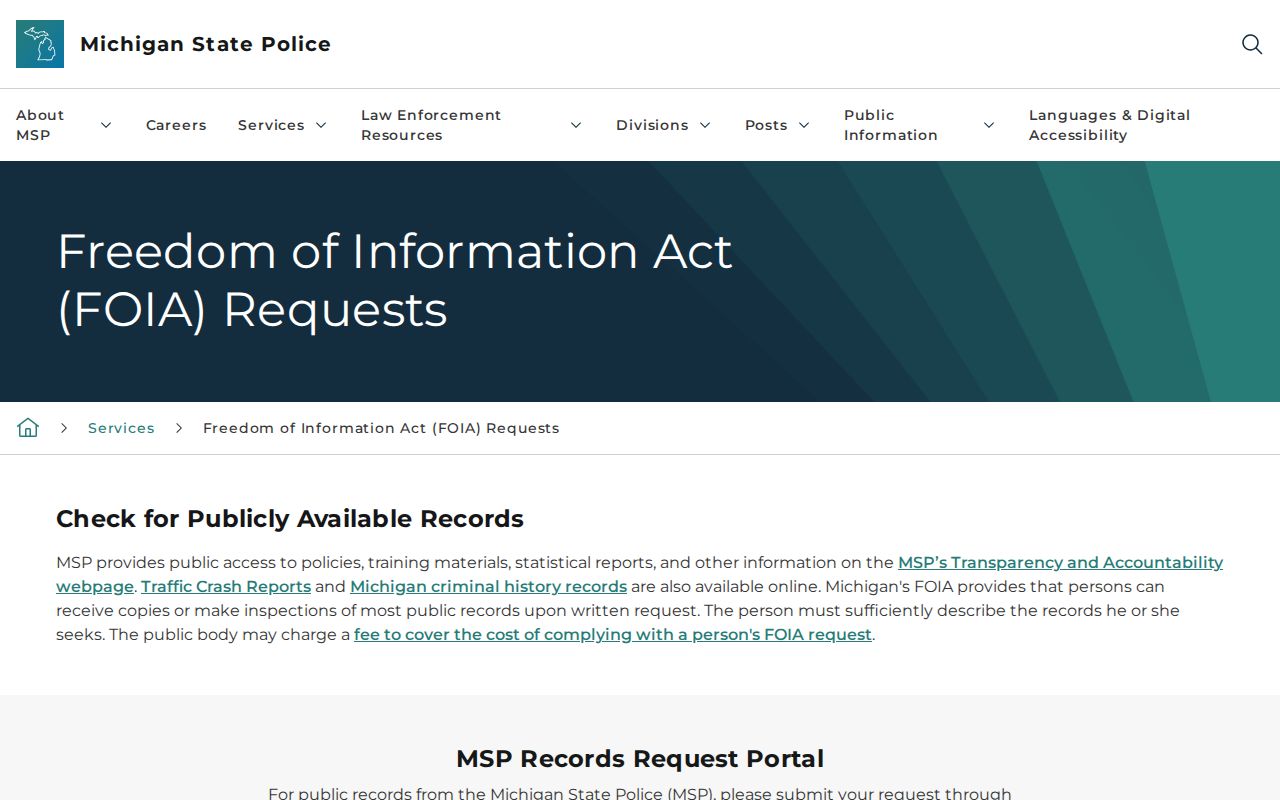
State and county images belong to different custodians. A Marquette County Jail booking photograph should first go to the Sheriff. An MDOC image should follow the state corrections record route. The Michigan State Police FOIA page is an official example of a separate state request channel, but it should not be substituted for the office that owns the requested jail or prison photo.
The captured state FOIA page below illustrates that agency-specific routing. It does not show a released-person gallery or a Marquette County booking photograph.
Routing the request to the record owner reduces delay and keeps the resulting image tied to a clear government source.