
Marquette County Three-Day Release Status
Marquette County offers no official browser page for releases during the last 72 hours. The Sheriff’s Jail Services page has no released-person archive, and no county page supplies a rolling three-day filter. As a result, there is no official feed URL, field list, update cadence, retention rule, or archived photo feature to publish. The accurate fallback is a date-range record request, not a reconstructed roster.
A three-day view serves a different need from a same-day check. It can cover an uncertain date or a period that crosses ordinary office days. Yet the wider range still needs agency detail. A person may have left the jail through bond, time served, sentence completion, court order, transfer to MDOC, or a federal handoff. A raw name and disappearance time cannot distinguish those results.
Check Marquette County 72-Hour Releases
Begin by fixing the date range. Use calendar dates rather than “the last three days” when asking for a record, because the county can then identify the precise span. A focused request can name one person or, if permitted and specific enough, ask for the release log covering those dates.
- Write down the person’s full booked name, birth date or booking number if known, and the three calendar dates at issue.
- Check MI-VINE through VINELink for an agency-supplied release or transfer event. Read the event literally.
- Use the Sheriff app only to see whether the person is currently shown after the app’s arraignment boundary.
- Review MiCOURT for bond, disposition, judgment, sentence, or transfer context.
- Submit the county’s online FOIA form for the date-range release record and any receiving-agency entry.
- If the county record shows an MDOC handoff, follow the person in OTIS rather than treating the jail exit as community release.
For an event confined to today, the Marquette County same-day release check uses a tighter time frame. The three-day route resolves an uncertain or cross-day event without asserting that a public rolling feed exists.
Marquette 72-Hour Request Fields
The county has not published the fields of a 72-hour release list because it has not published such a list. The following inventory defines a sound request. Some data may not exist under the same labels, and exemptions or lawful redactions remain the custodian’s decision.
| Requested field | Purpose in a three-day review |
|---|---|
| Booked name and identifiers | Separates people with similar names across the date range. |
| Booking number and booking time | Ties the exit to the correct custody episode. |
| Release date and time | Places the recorded event within the requested three days. |
| Release authority or type | Explains bond, time served, court order, sentence completion, or transfer. |
| Case number and charge entry | Connects the event to court records without proving conviction. |
| Receiving agency or destination | Shows whether custody continued elsewhere, if disclosable. |
| Custodian response or certification | Preserves the source and any statement that no responsive record was found. |
The release date and disposition must be read together. A court’s bond order may precede physical release. A dismissal may end a charge but not mark the minute jail processing finished. A transfer ends the Marquette jail episode while starting or continuing custody under another agency.
Marquette Weekend Release Date Ranges
No official Marquette County weekend release schedule or holiday-release rule was located. The Jail Services page does publish public-window closures, but those closures are not release-processing times. They must not be used to guess when someone exited. Likewise, no sourced policy identifies a family waiting area, exit door, transport arrangement, or standard property handoff.
The value of a 72-hour request is simple: it reduces the risk that an uncertain event is missed because it crossed midnight or an office day. State the actual start and end dates. Ask for the recorded release time and authority. If the event might have begun earlier, include the known booking date so the custodian can identify the right episode without a needlessly broad search.
MI-VINE notifications can occur when the supplying county jail or MDOC reports a covered custody change. They are strongest when registration happens before release. Retrospective availability is not promised, so a missing old result should lead back to the government record owner, not to an inference that no release occurred.
Crossing a weekend also increases the chance that different systems appear out of step. The court register may show an order on one day, MI-VINE may report an agency event later, and the jail’s recorded exit may carry its own timestamp. That does not mean one of the sources is necessarily wrong. Each system records a different act. Build the sequence from the court authority, the jail exit, and any receiving-agency handoff.
A “time served” sentence deserves the same care. It explains why continued custody may no longer be required in that case, but another case, warrant, or detainer can remain. Ask for the release disposition and receiving agency rather than converting the sentence time into an assumed exit. A bond entry also shows a legal condition, not the minute all jail processing ended.
Note: A court date inside the three-day span supplies legal context, but it does not replace the jail’s physical-exit record.
Obtain Marquette Three-Day Records
The county’s online FOIA request form asks for contact details, delivery choice, and a specific record description. It permits email, pickup, requester-made onsite copies, mail, or county-provided digital media among its listed choices. Ask for electronic delivery when practical. Include a fee ceiling and request advance notice before costs exceed it.
Michigan FOIA generally requires the coordinator to grant, deny, partly grant, or issue one allowed extension within five business days. A denial should identify its legal basis or certify nonexistence under the name used or known, explain redactions, and state appeal rights. MCL 15.244 requires nonexempt material to be separated and produced when practicable. No flat Sheriff price was found for a three-day release log.
A named-person request is often easier to identify than a broad list. If a release log exists for the dates and the request is sufficiently specific, the custodian can decide what is responsive and disclosable. For a person whose path is unclear across county, state, and federal systems, use the broader Marquette County release-record search.
Requesters should distinguish county and state records. If a person was sentenced to MDOC, the Marquette County record documents the transfer out of the jail. OTIS then shows state custody and may later show PAROLE with Date Paroled or a recent DISCHRG status. A future Parole Board Jurisdiction Date is an eligibility field, not proof of release during the requested three-day period.
Federal and immigration results are also system-bound. A county-to-USMS or county-to-ICE handoff is not a community release. The BOP locator can show a federal release result for its own system, while the ICE locator is designed for current adult detention and is not a release archive. A no-result cannot replace agency confirmation.
Marquette Release App History
The county’s local app history shows why screen captures cannot stand in for a 72-hour record. Marquette stopped using MobilePatrol in 2019 after reported accuracy concerns. The later Sheriff-controlled app was introduced as an inmate lookup with publication after arraignment. A person may therefore be absent before the app publishes the record, after a custody change, because of timing, or because of a correction.
The local MobilePatrol shutdown report documents that history. Its captured page appears below as evidence of the discontinued channel, not as a current Marquette County release source.
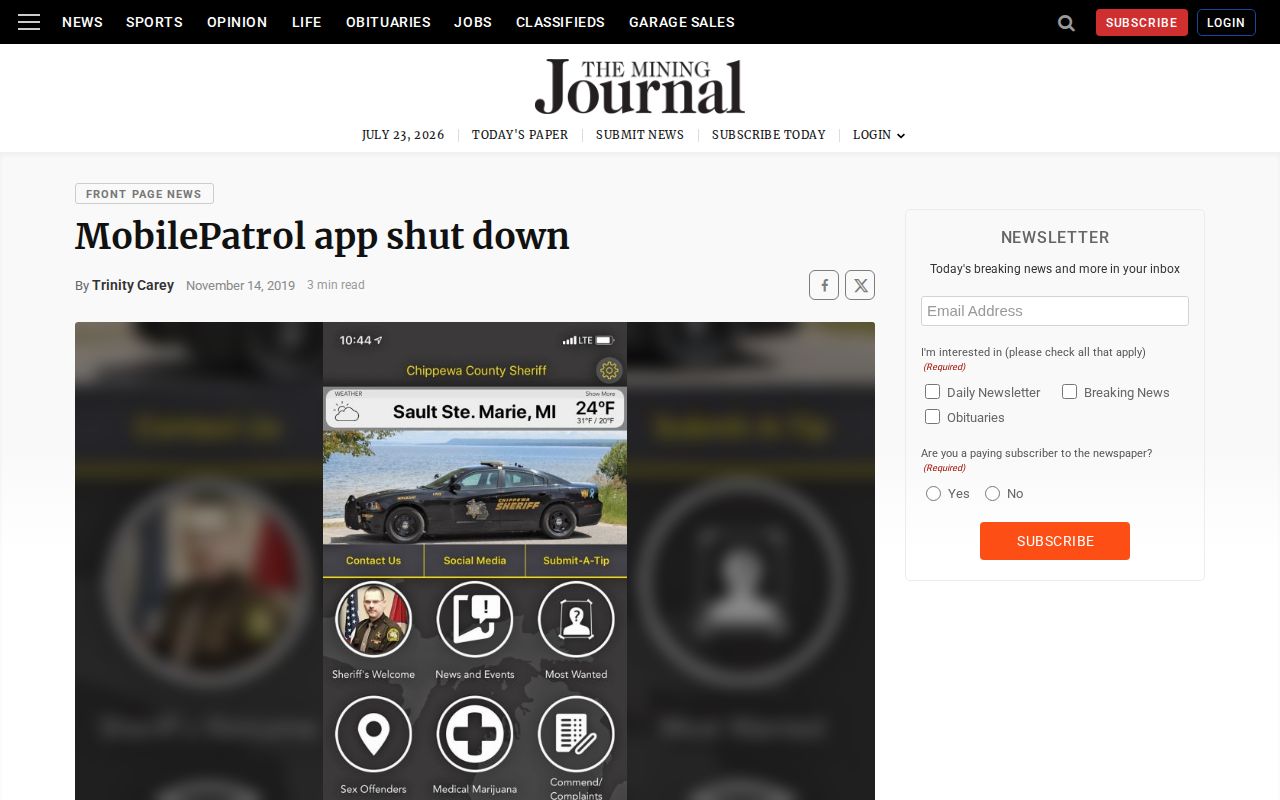
The lesson is specific to Marquette: use the MCSO app for a present-status clue, then use MI-VINE, court records, and the jail record to explain the event.
Marquette Three-Day Release App Limits
The official Sheriff app is listed in Google Play. Its store description does not advertise a 72-hour archive, a released-person window, or release-notification service. The listing confirms an official mobile channel but not any historical fields or retention period.
The image below shows the official Android listing from the manifest. It should be read alongside the county’s lack of a browser feed, not as a substitute for one.
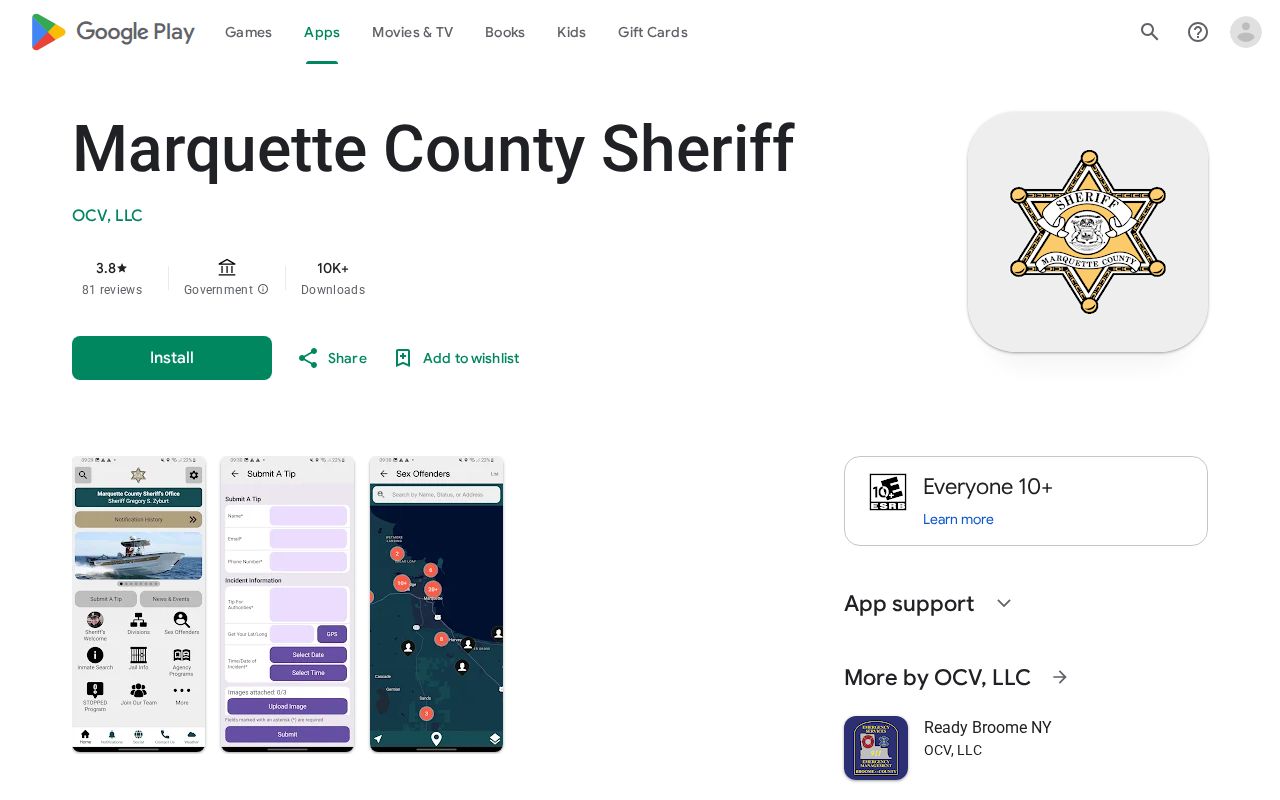
For the three-day question, the decisive source remains the release record for the stated dates and the named custody episode.
No official Marquette County record-retention rule was found for the app’s current listing, a released-person photo, or the underlying release entry. If an older record cannot be produced, ask which retention authority or disposition applies. The absence of a public app item says nothing by itself about whether the government still holds a responsive record.