
Where Marquette Branch Releases Go
Marquette Branch Prison is a Michigan Department of Corrections institution, not a Marquette County jail. A person who leaves on parole enters the community while remaining under MDOC supervision. The public OTIS profile can then show PAROLE, a supervising location, and Date Paroled. Date Paroled is the historical field that identifies the day the person left prison on parole. It is stronger evidence of physical release than an eligibility date or a favorable Parole Board action.
A final discharge is different. OTIS uses DISCHRG when MDOC jurisdiction over the sentence has ended. That date may follow a prior parole period, or it may reflect the endpoint of a sentence without parole. It should not automatically be treated as the day the person walked out of Marquette Branch Prison. Read the status, Date Paroled, sentence history, and court record together. If OTIS no longer displays the person, a formal MDOC record can preserve the chronology.
Transfers remain custody. A move from Marquette Branch Prison to another MDOC institution changes location but does not create a released person. Likewise, a warrant, detainer, or another sentence may affect where someone goes after one MDOC event. The Marquette County released-inmate search path explains how to follow county, state, federal, and immigration custody without blending their records.
Release check: PAROLE with Date Paroled supports actual prison exit. A new prison location or positive parole action alone does not.
Confirm Marquette Branch Prison Release
The correct public lookup is the MDOC OTIS search form. OTIS covers current prisoners, parolees, and probationers under MDOC, plus people discharged within three years of their most recent MDOC discharge. It does not cover jail-only detention at Marquette County Jail. Search the state system first, then use the court judgment or a formal MDOC request when the result needs more context.
- Search by MDOC number when known. It is the most precise identifier. Otherwise, enter at least a last name and refine with first name, age, sex, race, or status.
- Open the matching profile. Confirm the MDOC number, identifying details, controlling sentence, and location before relying on any date.
- Read status and location together. PRISON means state custody continues. PAROLE points to community supervision, while DISCHRG means MDOC jurisdiction ended.
- Look for Date Paroled. Do not substitute Parole Board Jurisdiction Date, which OTIS defines as the earliest release date, or Maximum Date, which is a potential sentence endpoint.
- If the profile is absent or incomplete, check the sentencing court and request appropriate MDOC records using the full name, MDOC number, and case information.
OTIS can remove a discharged profile from public display after its three-year window. It can also omit information made nonpublic through set-aside or operation of law. A blank search is therefore not proof that no state record exists. The MDOC FAQ describes formal PENPACK material that may include a Basic Information Sheet, Judgment of Sentence, Parole Eligibility Report, photograph, and Discharge Certificate when available and disclosable.
The status filters help narrow a common name. OTIS offers categories for prisoners, parolees, probationers, discharged people, and parole or probation absconders. A parole absconder remains under supervision and is not a newly released person. A probation profile also does not prove that the person served a prison term. Confirm the profile's sentence and location before describing the custody history.
| OTIS field | How to read it |
|---|---|
| PAROLE | Prison custody ended, but MDOC community supervision continues. |
| Date Paroled | Historical date the person physically left prison on parole. |
| Parole Board Jurisdiction Date | Earliest point for Board jurisdiction, not an assured exit. |
| Maximum Date | Potential sentence endpoint under the governing sentence. |
| DISCHRG | MDOC jurisdiction ended; check whether prison exit happened earlier. |
| Location | Shows whether a prison or community supervision office is associated with the profile. |
The profile should be treated as a set of related fields, not a single label. For example, PAROLE without careful identity matching could belong to a different person with the same name. Date Paroled without the status and controlling sentence may omit the later supervision story. An MDOC number, case number, and court judgment make the match more reliable.
Marquette Branch Release Contacts
The facility can answer institutional questions, but OTIS and MDOC records are the proper release-record channels. A prison contact should not be asked to turn an expected date into a guarantee. For a record request, identify the person by name and MDOC number and name the document sought, such as the Discharge Certificate or public parole material.
Marquette Branch Prison
1960 U.S. Highway 41 South
Marquette, MI 49855
Phone: 906-226-6531
Email: MDOC-Marquette-Public@michigan.gov
Questions about a public OTIS field can also be checked against the OTIS field guide. Court-derived errors should be addressed through the sentencing court. Supervision or status issues belong with the supervising agent or office. General stale or inaccurate OTIS information may be reported to correctionsinfo@michigan.gov. These routes matter because the prison, court, parole office, and public database each own different parts of the record.
A focused MDOC request should state the document and custody episode instead of asking for “everything.” Include the full name, MDOC number, sentencing court, case number if known, and the date range. Ask for electronic delivery when useful and request a written explanation of any withholding. The public OTIS window and underlying MDOC retention are not the same thing, so a profile that has aged out does not by itself settle whether an agency record remains.
Marquette Branch Prison Facts
The official MDOC facility page identifies Marquette Branch Prison as a men's prison for adults and lists custody Levels I and V. These levels describe institutional security. They do not predict whether a particular person will receive parole. The sentence, eligibility law, Board action, placement work, and actual processing control the release path.
MDOC also identifies the prison as an Offender Success and Prisoner Reentry facility serving all fifteen Upper Peninsula counties. Some people with positive parole action may be housed there for in-reach services. That placement is preparation, not release. It shows why location and program participation cannot replace the later OTIS status and Date Paroled.
Security level is equally limited as release evidence. Level I and Level V describe distinct custody settings within the state system. Neither label supplies an eligibility date or Board outcome. A person can also move within MDOC for placement, services, safety, or management reasons without any release event. The public profile's status and location document that continuing state custody.
Marquette Prison Reentry Before Release
Marquette Branch Prison's local role extends beyond secure custody. The MDOC facility description lists in-reach work that may include transportation coordination, workshops, Fast Track Release, field agents, and coordination with treatment providers, community groups, and family. These steps can help prepare an approved person for the transition out of prison. They do not certify that the transition occurred.
A positive parole action begins more work. MDOC describes release processing and placement review after the decision, and its parole materials warn that a proposed action can be delayed, suspended, amended, or rescinded. There is normally a gap between Board action and physical release. The safe sequence is: judgment and sentence, Parole Board Jurisdiction Date, Board action, release processing, then OTIS PAROLE with Date Paroled. Skipping the last step creates a false release claim.
- Positive parole action
- A favorable Board decision that starts release processing. It is not proof of exit.
- Parole
- Release from prison into the community while MDOC supervision continues.
- Discharge
- The end of MDOC jurisdiction over the sentence, which may occur after parole.
- Transfer
- A move between custodians or institutions while confinement continues.
Marquette Prison History and Release
Marquette Branch Prison dates to 1889. Its long operation and combined Levels I and V make it a distinct part of the Upper Peninsula corrections system. The historical fact is useful context, but it should not be used to infer a person's current location or release route. Current OTIS data and MDOC records control those questions.
The contrast with the county jail is also important. Marquette County Jail handles local and some federal custody, while Marquette Branch Prison is a state institution. A person transferred from the jail to this prison has left the county building but has not been released. The county booking/release record should show the handoff, and OTIS should show the state custody path. Later parole is a separate event recorded by MDOC.
The manifest image below comes from the official Marquette Branch Prison page.
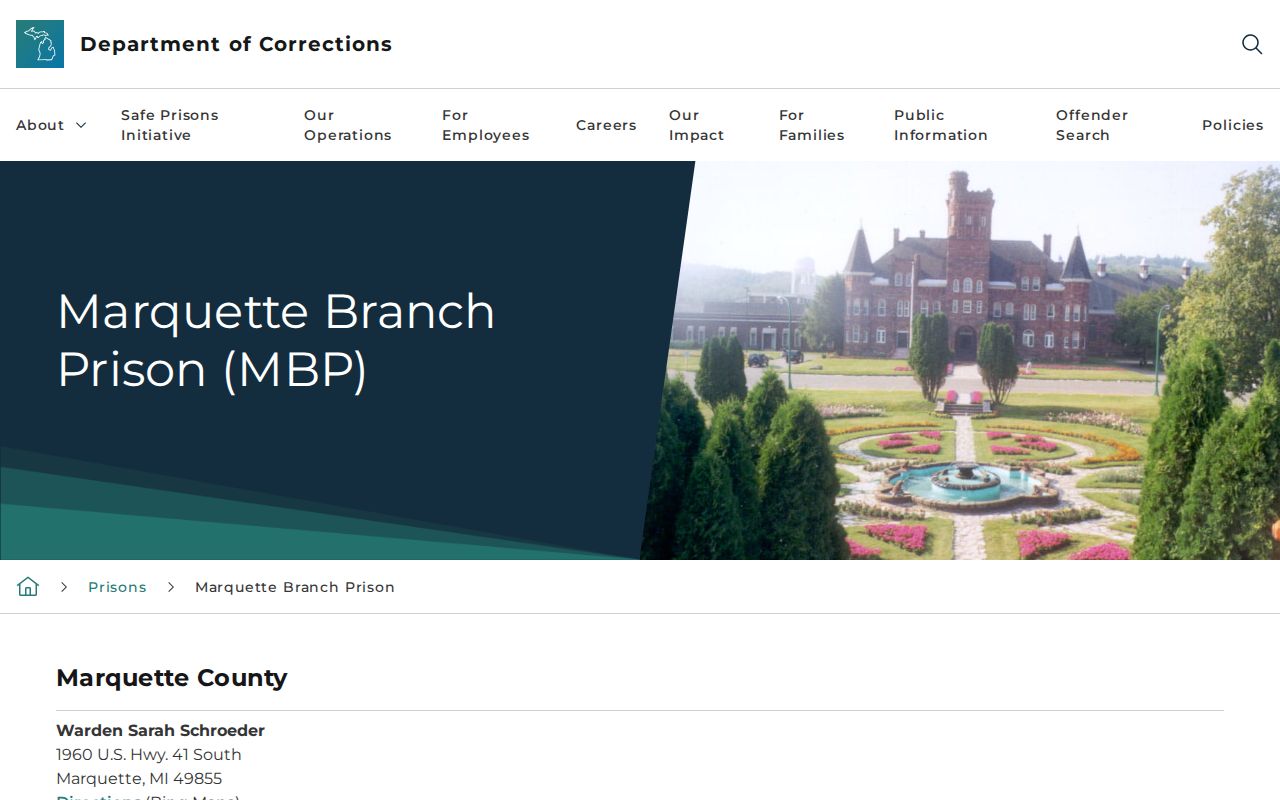
The official page anchors the facility's state-prison role and its Upper Peninsula reentry function, both of which point release checks back to MDOC.
Note: A release from Marquette Branch Prison is a state event; a Marquette County jail roster cannot confirm it.