
Marquette Parole and Probation
Parole is release from an MDOC prison before the maximum sentence ends, with the person still under Michigan Department of Corrections jurisdiction. The public OTIS profile may show PAROLE, a supervising location, and a Date Paroled. That date is the strongest public OTIS field for the actual prison exit. Marquette County probation has two main tracks. A felony probation term ordered by the 25th Circuit Court is supervised through MDOC. A misdemeanor probation term ordered by the 96th District Court is handled through the separate district probation office. A PROB status therefore confirms MDOC probation, not a past prison release.
The distinction controls which office can verify the record. A jail-only case may end with district probation and never appear in OTIS. A person sentenced to prison may later leave on parole and remain in OTIS. Someone may also receive circuit-court probation without entering prison. Start with the sentence, not an assumption based on the word “supervision.” The 96th District Court handles misdemeanors and felony preliminary stages, while felony judgments come from the circuit court.
| Record type | How it begins | Best verification |
|---|---|---|
| Parole | Release from an MDOC prison | OTIS PAROLE status, Date Paroled, and local MDOC office |
| Felony probation | Circuit-court sentence | OTIS PROB status, court record, and local MDOC office |
| Misdemeanor probation | 96th District Court order | MiCOURT record and district probation office |
| Final discharge | MDOC jurisdiction ends | Recent OTIS DISCHRG status or formal MDOC record |
- Parole
- Community supervision after a person physically leaves state prison.
- Probation
- A court-ordered community sentence that does not itself prove a prison stay.
- Discharge
- The end of MDOC jurisdiction over the sentence or supervision term.
- Absconder
- A person recorded as having unresolved contact or compliance status with supervision.
Verify Marquette Post-Release Supervision
The Michigan OTIS offender search is the first public check for state parole or felony probation. Search with the MDOC number when known because it is unique. Otherwise, use at least a last name and narrow the result by first name, age range, sex, race, or status. Open the full profile. A name-only result can match a different person, and a status label must be read with the location, sentence, and dates.
- Identify whether the case came from the 96th District Court or 25th Circuit Court and whether the person served a county-jail or MDOC prison term.
- Search OTIS for an MDOC number or last name. Read PAROLE, PROB, ABSCOND1, ABSCOND2, or DISCHRG in its defined context.
- For a parole record, compare Date Paroled with the status and supervising location. An eligibility date is not the physical-release date.
- Check MiCOURT for the judgment, probation order, amended sentence, or discharge entry tied to the case.
- Contact the correct local office when the public record is unclear. State parole and felony probation go to MDOC; misdemeanor probation goes to 96th District Probation.
A county-jail release record answers a different question. It can show when Marquette County Jail custody ended and whether the person entered the community or another agency’s custody. It does not establish an MDOC supervision term by itself. The full county release-record path is available from the Marquette County released-inmate search.
Note: OTIS excludes jail-only sentences, so an empty result never rules out Marquette County district probation.
Marquette State Supervision Office
Marquette County’s state parole and felony probation contact is listed in the MDOC Region 1 directory. The county probation page identifies Stephanie Gordon as supervisor. The office can help route a question about a current MDOC supervision record or a status correction. It is not the source for a district-only misdemeanor case, and it cannot turn a favorable Parole Board action into proof that prison release occurred.
Marquette County Parole/Probation
Courthouse Annex, Ground Floor, Room 36
234 W. Baraga Street
Marquette, MI 49855
Phone: 906-225-8224
Fax: 906-228-6248
The official Marquette County probation page visually confirms the state and district contacts.
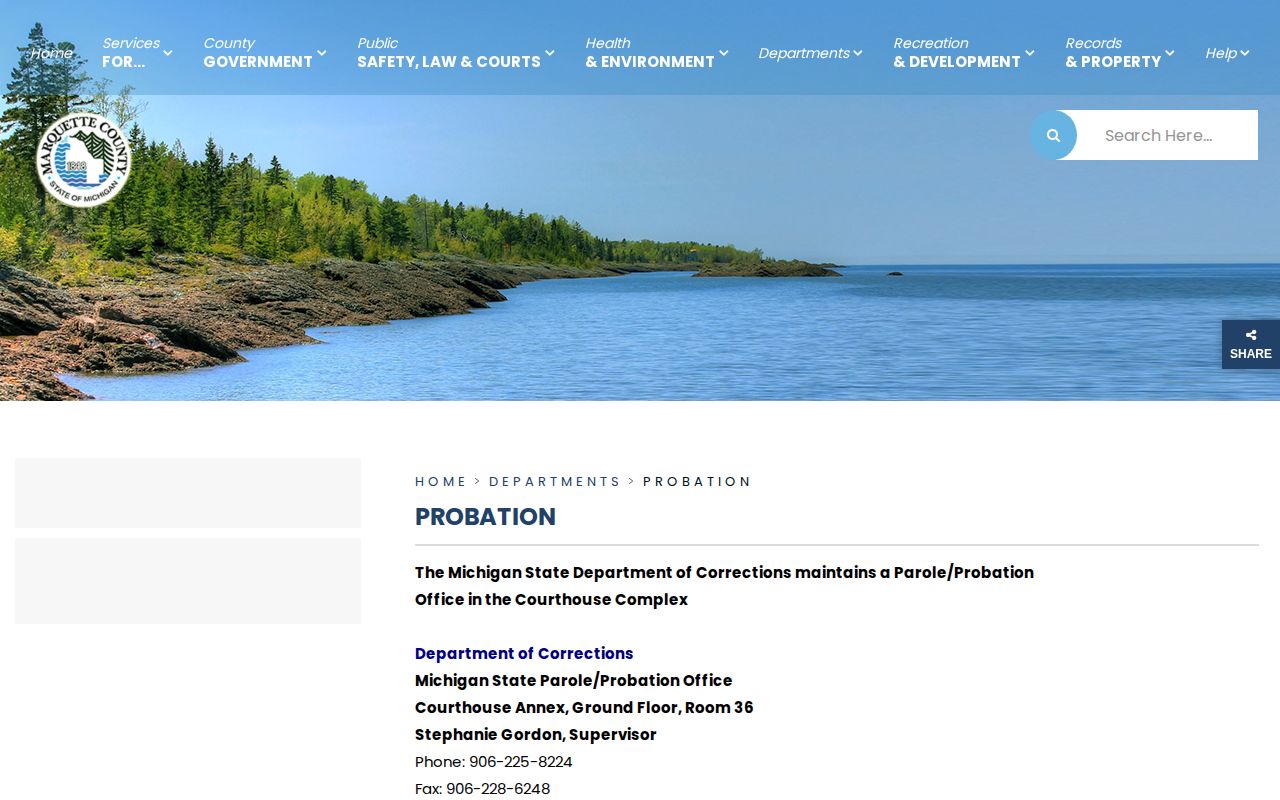
The contact split on that county page matters: it keeps a state parole or felony probation inquiry from being sent to the district misdemeanor office.
Marquette District Probation Is Separate
The 96th District Court Probation office uses 906-225-8250. It handles district misdemeanor supervision. This local separation is more than an office detail. It explains why a person can be on Marquette County probation while having no OTIS profile. OTIS tracks MDOC prisoners, parolees, felony probationers, and recently discharged MDOC cases within its public scope. It does not absorb every county court sentence.
Use the MiCOURT register to confirm the district case, sentence, probation term, and later orders. A probation order is a legal status record. It is not the jail’s physical exit record. If the exact release time from Marquette County Jail matters, request the Sheriff’s booking and release entry. If the issue is whether district supervision remains open, use the court and district probation office. Keeping those questions apart prevents a court date, jail date, and supervision date from being merged into one event.
Marquette Parole Decisions and Release
The Michigan Parole Board generally decides cases through a three-member panel. The consideration process begins before the eligibility or reconsideration point and may include a secure video interview. A grant sends the case into placement and release processing. MDOC research indicates that at least 28 days normally separate a Board decision from physical release. New information, misconduct, or an unresolved placement can still delay, suspend, amend, or rescind a positive action.
A CFJ-700 Notice of Action can record a grant, denial, or deferral and may include a proposed date. A denial continues service. A deferral means more information or another step is needed. None is an exit scan. Confirm the event in OTIS: PAROLE paired with Date Paroled supports actual prison release into supervision. DISCHRG means MDOC jurisdiction has ended, which can occur after a past parole term or at another sentence endpoint.
Routine person-by-person parole interviews are not published in a general public calendar on the official pages located for Marquette County. The Public Hearing Registration schedule is limited to legally public lifer-parole and clemency hearings. MDOC posts those notices through press releases, generally about two weeks to thirty days before a hearing, and registration closes two business days before it. Quarterly legislative reports provide aggregate grants, denials, and deferrals, not an individualized decisions search. The prisoner receives the decision notice, while OTIS later supplies public status and Date Paroled when release occurs.
Marquette Parole Absconder Status
OTIS uses ABSCOND1 for a parole absconder actively sought by MDOC and ABSCOND2 for a probation absconder under the sentencing county’s jurisdiction. These labels describe an unresolved supervision status. They do not mean a new release occurred. An old article, a past release notice, or a former location cannot resolve current status. Use the OTIS profile and the supervising office.
A possible warrant or violation is also distinct from a confirmed jail booking. Check the relevant court record and current agency record. If the person is back in Marquette County Jail, the Sheriff’s current-custody channel and MI-VINE address that custody episode. For a federal warrant or federal custody, OTIS is not the correct system. The federal court record, USMS stage, or BOP locator must be checked within its own scope.
Note: An absconder label concerns supervision compliance and should not be reported as a fresh Marquette County release event.
Marquette Reentry Before Parole Release
Marquette Branch Prison serves as MDOC’s Offender Success and Prisoner Reentry facility for all fifteen Upper Peninsula counties. It may house prisoners with positive parole action who need in-reach services. The facility lists release-preparation work such as transportation coordination, workshops, Fast Track Release, field-agent contact, treatment coordination, and links with community or family support.
That role creates a key local caution. Placement at the prison for reentry work still means the person is in MDOC custody. Program participation does not prove release. A positive action does not prove release either. Look for the later OTIS PAROLE status and Date Paroled. Separately, Marquette Regional Community Corrections lists local pretrial and structured programs. Those programs provide context, not a universal sign of community release.
Marquette Supervision Discharge Records
Supervision ends through a discharge authorized under the governing sentence and agency process. OTIS uses DISCHRG when MDOC jurisdiction over the sentence has ended. That date is not always the date the person left prison. Someone may have departed prison earlier on parole, served the community term, and then reached discharge. Others may reach maximum discharge without parole. Read Date Paroled, status history, the judgment, and the discharge record as a sequence.
Public OTIS information ordinarily remains for three years after the most recent discharge, subject to set-aside and other legal limits. When a recent public profile is too thin, MDOC records may supply a Discharge Certificate or other available PENPACK material. A set-aside can later make the retained official record nonpublic under MCL 780.623. For any live status question, use the record owner. Court-derived errors go to the sentencing court, while supervision and absconder issues go to the agent or MDOC office.